The three cotton producing north Indian states — Punjab, Haryana and Rajasthan — have witnessed a decline of 43% in arrival of kapas (unginned cotton) till November 30 this year compared to the same period last year.
The sharp reduction is causing concern across the supply chain, with some farmers holding back their produce in hopes of higher prices, while ginners and spinners are facing raw material shortages, particularly in Punjab.
Even though the arrival season is still continuing, experts attribute the low arrival till November to reduced acreage, lower yields, and farmers delaying sales, anticipating a price rise in the coming months.
Currently, kapas is being sold at prices ranging from Rs 6,250 to Rs 8,340 per quintal, with most of the crop being sold close to the Minimum Support Price (MSP). Cotton arrival season begins from October 1 in the North Zone and continues till September 30 but major portion of crop arrives in mandis by this time of the year. The cotton picking begins in September in north and ends by November.
The three cotton producing states of Punjab, Haryana and Rajasthan in the North Zone have this year witnessed a combined production of around 54 lakh quintal in kapas, which comes to around 9.75 lakh bales. One bale is equal to 170 kg of lint, which is ginned cotton or cotton separated from its seed. Till November 30, 2023, 86.15 lakh quintals or 17.23 lakh bales had arrived in mandis last year.
Punjab has witnessed the lowest arrival of only 1.57 lakh quintals of kapas this year against 5.40 lakh quintals during the same period last year. Haryana and Rajasthan have received 13.75 lakh quintals and 32.50 lakh quintals, respectively till November end against 24.25 lakh quintals and 56.50 lakh quintals in the same period last year.
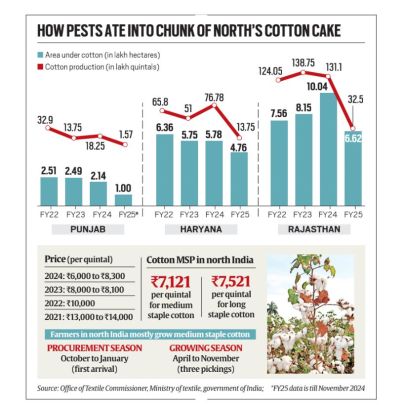
The three states have also witnessed a significant decline of around 5.58 lakh hectares in the area under cotton cultivation this year (2024-25), with Punjab leading the chart at 50% less area compared to last year.
In Punjab, area under cotton reduced from 2.14 lakh hectares last year to just 1 lakh hectares this year. Rajasthan saw a decline of 34% with the area under cotton dropping from 10.04 lakh hectares last year to 6.62 lakh hectares this year. Haryana witnessed a 17% decline, with cotton area decreasing from 5.78 lakh hectares to 4.76 lakh hectares.
These states have also been grappling with repeated attacks of pink bollworm in recent years, which has eroded farmers’ confidence in growing cotton. Experts have said that Punjab is the worst affected and several years ago, the area under the corp was around 8 lakh hectares. If the Punjab government is serious about diversification and saving the cottonbelt, it should invite scientists from across India to investigate the root cause of the pest attack and develop solutions, experts said.
Similarly, cotton prices remained relatively strong and above MSP in the last three years but significanly droped this year.
In 2021, the crop was sold at Rs 13,000 to Rs 14,000 per quintal, in 2022 for around Rs 10,000 per quintal, and in 2023 at Rs 8,000 to Rs 8,100 per quintal. For the current season, cotton price in Punjab is ranging between Rs 6000 per quintal and Rs 8300 per quintal but most of the crop was sold at Rs 7,400 to Rs 7,500 per quintal which is almost same as the MSP. The MSP for cotton is is set at Rs 7,121 per quintal for medium staple cotton and Rs 7,521 per quintal for long staple cotton. Farmers in north India mostly grow medium staple cotton.
Bhagwan Bansal, president of the Punjab Ginners’ Association, said that the decline in cotton arrivals is creating severe challenges for Punjab’s ginning and spinning industries. “In 2004, the state had 422 ginning units but now the number has gone down to only 22. Many ginners are now relying on raw material imports from Gujarat, Maharashtra, and Karnataka to sustain operations. The situation in dire in Punjab and most ginners and spinners are running their units at less capacity due to supply shortages. Importing cotton from other states is essential to keep the industry alive but comes at a high cost due to exorbitant transportation charges,” Bansal said.
Bansal emphasised the need for high-yielding varieties such as Bollgard-3 cotton and scientific collaborations with countries such as Brazil, where yields reach up to 18 quintals per acre compared to Punjab 7-8 quintals, which have now reduced further to 4-5 quintals owing to pest attack. “Without such advancements, Punjab’s cotton industry will continue to struggle,” he said.
Farmers and industry stakeholders have also urged the state government to adopt proactive measures, including collaborations with international agricultural experts and reforms to address recurring issues such as pest attacks, particularly pink bollworm infestations. “If the government is truly sympathetic towards farmers and the cottonindustry, it must act now,” said Bansal, adding, without intervention, Punjab’s cottonsector may face further decline.
Echoing similar sentiments, Sushil Mittal, president of the Haryana Ginners Association and owner of Aditya Agro in Sirsa, said that by the end of November this year, Haryana had received approximately 2.75 lakh bales, equivalent to 13.75 quintals of kapas in the mandis. “This figure is lower compared to the same period last year. The area under cottoncultivation has also significantly decreased from the previous season, and we are expecting a production decrease of around 20 to 25%. The arrival season is still ongoing and will continue until September 30, 2025, but the majority of the crop typically arrives in the mandis between October and mid-January each year.